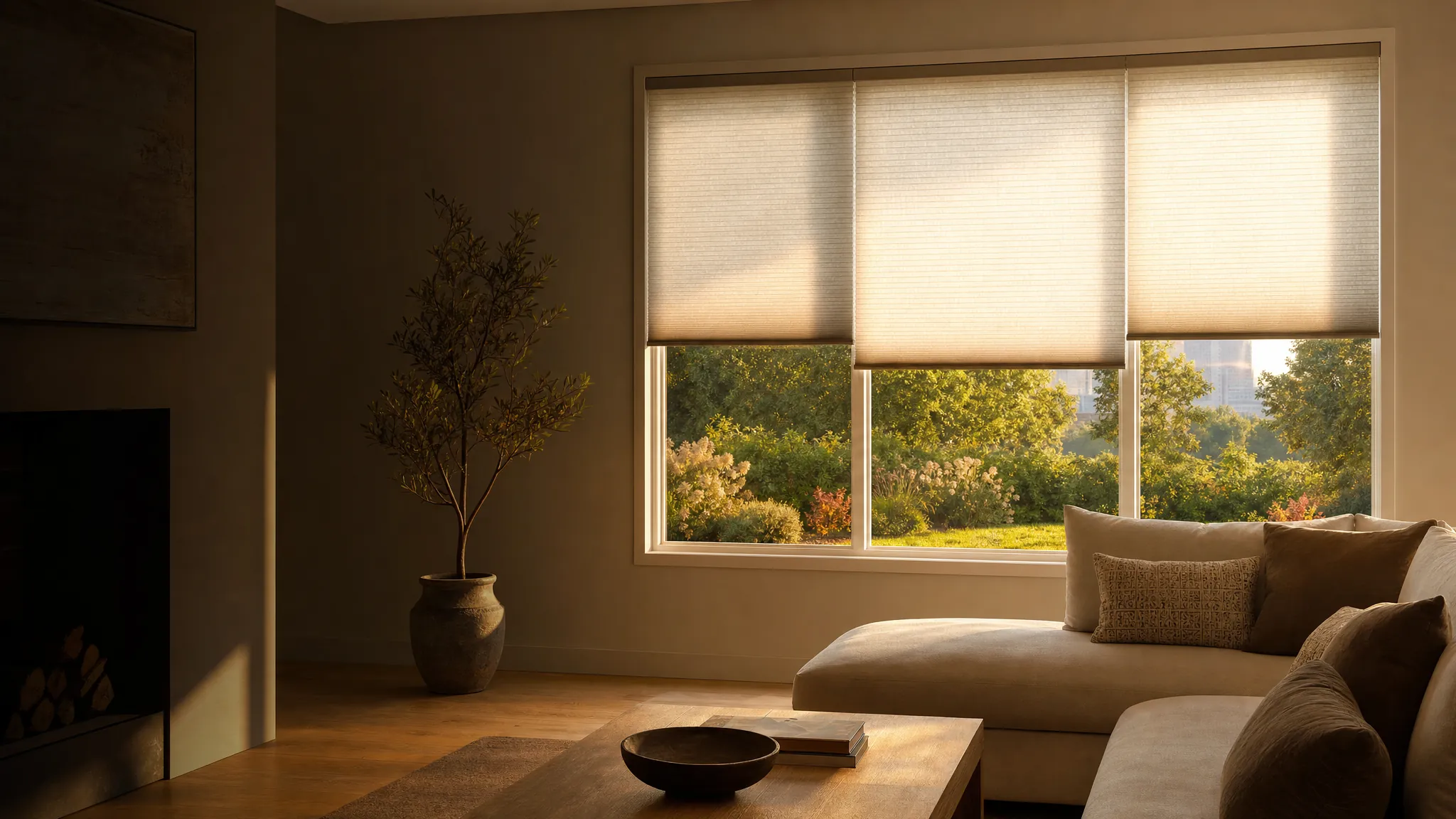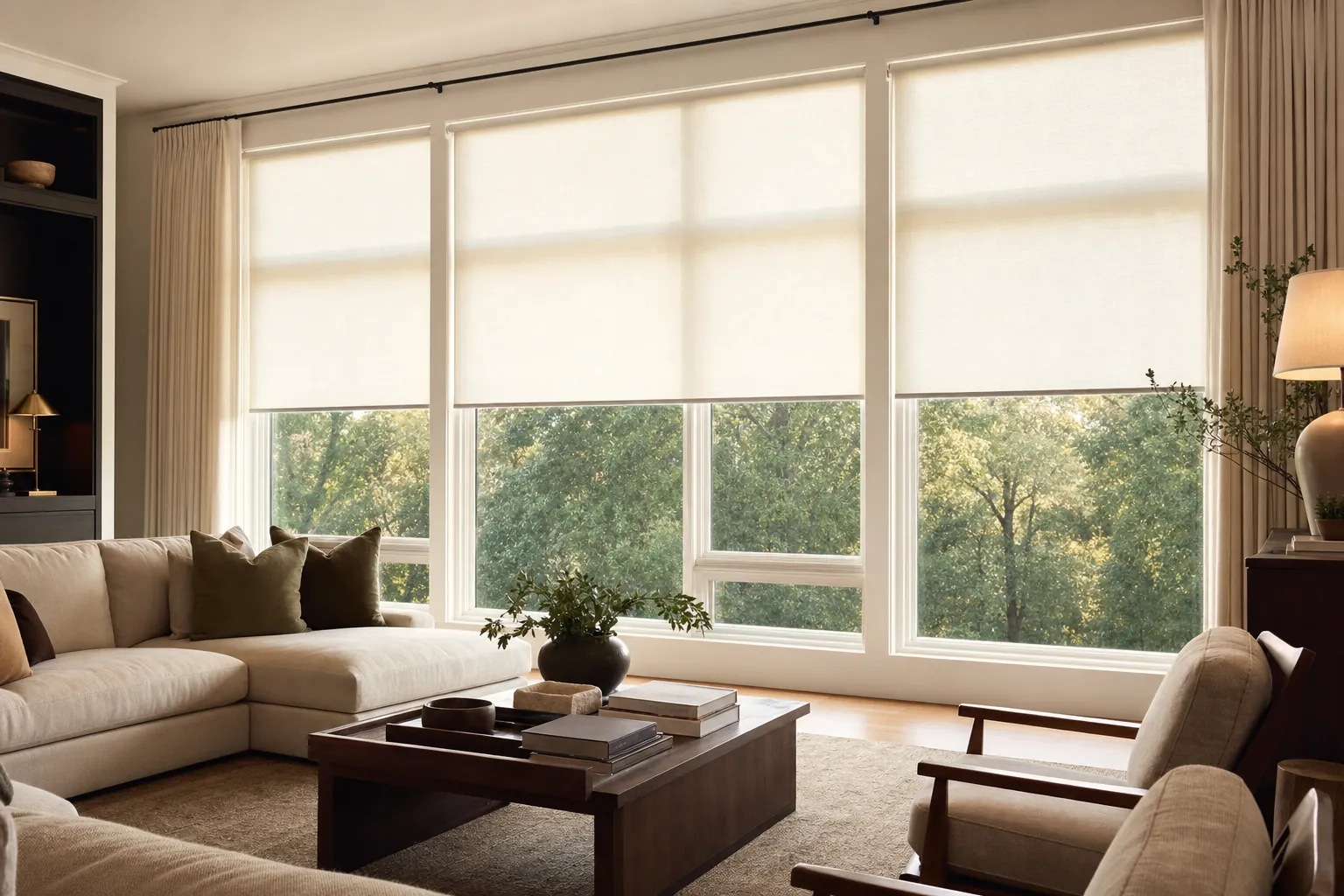

Solar shades and roller shades share the same clean, low-profile form, but they do not make a room feel the same. A solar shade is built to soften glare while holding on to a connection with the view. A roller shade can do that too, but it can also become a light-filtering, room-darkening, or blackout layer when privacy and coverage matter more than seeing outside.
The useful choice is not about which name sounds more premium. It is about what needs to happen at the glass when the room is hardest to use. A bright living room may need screen-friendly daylight and a view of the trees. A bedroom may need to feel private after dark. A home office may need both a clear view and relief from reflected light. This guide separates the two options so the fabric, mount, and final treatment match the real job.
The short answer
Choose solar shades when the view is important, daytime glare is the problem, and you want the room to stay connected to the outdoors. They are a strong fit for living rooms, home offices, kitchens, high-rise glass, and large windows where an opaque shade would make the room feel closed down.
Choose roller shades when you need more flexibility in fabric and coverage. A roller shade can use solar fabric, but it can also use a tighter light-filtering fabric, a room-darkening fabric, or a blackout fabric. That makes roller shades the better starting point for bedrooms, street-facing rooms, media spaces, and any window that needs reliable nighttime privacy.
Both can look equally tailored. The difference is what the fabric allows through. Thinking about that first prevents the common mistake of selecting a beautiful solar fabric for a bedroom, then discovering that it performs well in the afternoon but leaves the room too exposed once the lights come on.
What solar shades do best
Solar shades are roller shades made with a screen-like woven fabric. The small openings in that fabric filter direct sunlight and reduce visual glare while allowing some view through the shade. The experience is similar to wearing sunglasses in a bright room: the light is calmer and the view remains present, though it is softened by the weave.
That makes solar fabric useful in rooms where the window is a feature rather than a problem to cover. A living room facing a garden, a home office with a skyline view, or a large wall of glass can keep much of its openness while becoming more comfortable to use. The shade does not need to turn the room dark to take the sharp edge off the sun.
Solar shades are especially practical for glare. They can reduce the contrast that makes a laptop screen, television, or dining table uncomfortable during a bright part of the day. The U.S. Department of Energy's research on window treatments explains why the position and use of a treatment matters, especially when a window receives direct solar gain. A shade that stays raised while the late sun hits the room cannot do the job it was selected to do.

What roller shades do best
Roller shade describes the mechanism, not one specific fabric. The shade rolls into a compact tube above the window, then lowers as a smooth, continuous panel. That simple form is useful because it can adapt to different room needs without changing the clean silhouette.
A light-filtering roller fabric can soften daylight while offering more visual separation than an open solar weave. A room-darkening roller fabric can reduce brightness substantially in a bedroom or media room. A blackout roller shade, paired with a carefully planned mount and side coverage, can offer the strongest coverage of the group. The roller-shade overview from Hunter Douglas is a helpful example of how broad the fabric and operating options can be within the same basic shade form.
This flexibility is why roller shades are often the better answer when a window has different needs by time of day. A street-facing den may want soft daylight in the morning and privacy after sunset. A bedroom may need the room to feel lighter during the day but substantially darker at bedtime. A solar fabric alone cannot always make that transition. A more opaque roller fabric, or a roller shade layered with drapery, can.

View and daylight: where solar shades win
If the view is one of the reasons you love the room, solar shades deserve a close look. Their fabric can reduce glare without replacing the world outside with an opaque wall of cloth. The right openness level determines how much view and daylight stays in the room. A more open weave keeps the view clearer but lets in more light and provides less screening. A tighter weave gives stronger glare control but softens the view more noticeably.
Color changes the experience too. Darker solar fabrics often preserve the outward view more clearly because they reduce reflected light on the room side. Lighter fabrics can make the room feel softer and brighter, but they may reflect more of the interior back toward the glass. Neither is automatically right. The better fabric is the one that works at the time the room needs help, not only under showroom lighting.
For a window that catches hard afternoon sun, start with the sun path. A room with western exposure may need a different fabric and schedule than a room that gets gentle morning light. Lionheart's guide to west-facing window treatments is useful when glare and heat build late in the day. For a tall bank of glass or an open living space, the guide to large-window treatments can help narrow down the scale and operation plan.
Privacy after dark: where roller shades are safer
Daytime privacy and nighttime privacy are not the same problem. During the day, the outdoors is usually brighter than the interior, so a solar shade can make it harder for someone outside to see in. After dark, lamps and interior lighting reverse that contrast. An open-weave solar fabric can still reveal silhouettes, light, and movement from the street or a neighboring home.
That is not a flaw in solar shades. It is simply the tradeoff that makes their view-through quality possible. They are a great daytime layer, but they should not be sold as a stand-alone privacy solution for every room. Bedrooms, bathrooms, street-facing living rooms, and windows close to a neighbor often need a more opaque roller shade, lined drapery, or a second layer that can close when the house is lit from within.
Roller shades make that planning simpler because the fabric can be selected around the privacy job. A light-filtering roller shade can make a room feel soft without exposing it as much as an open solar weave. A room-darkening or blackout fabric can provide stronger coverage. If the window is shallow, oversized, or has valuable trim, the choice between an inside and outside mount also affects light gaps and privacy. See the inside-mount versus outside-mount guide before assuming the fabric alone will solve the edges.
Heat, glare, and comfort
Both solar shades and roller shades can help a room feel more controlled, but neither should be treated as a magic energy product. The fabric, color, openness, fit, glass type, direction of the window, and daily use all shape the outcome. The most valuable change may be reducing a blinding patch of late sun on a sofa, making a laptop usable without closing the room, or stopping a west-facing bedroom from feeling harsh at the end of the day.
Solar shades tend to be the more natural choice when glare relief and view preservation are the main priorities. A darker or tighter solar fabric can reduce the sun's intensity while keeping a visual connection outside. A room-darkening roller fabric is better when the room needs a more decisive barrier. Cellular shades can be worth considering when the room feels uncomfortable beside the glass and insulation is the stronger concern. Lionheart's cellular shade guidance explains where that construction can make more sense than a flat roller fabric.
For many Atlanta homes, the most useful solution is not a single treatment asked to solve every problem. A solar shade may handle daytime glare, while drapery closes in the evening. A roller shade may provide light control, while a second layer brings softness and stronger privacy. Matching each layer to one clear job gives the room better performance and a more intentional finish.
Understanding openness before you choose solar fabric
Solar shade fabrics are often described by openness, which refers to the small percentage of open space in the weave. It is a helpful starting point, but it is not a universal score for privacy or heat control. The same openness can look and perform differently depending on fabric color, window direction, exterior light, and the contrast between indoors and outdoors.
A more open solar weave keeps a clearer connection to the view. It can be a natural choice for a bright living room, a condo with a skyline, or a breakfast room that looks onto a garden. The tradeoff is that it filters less of the daylight and gives less visual screening. If the sun is especially strong, the room may still need a tighter fabric or a second layer at the time of day when the glass becomes uncomfortable.
A tighter solar weave gives a more subdued view and can calm a bright room more noticeably. It is often useful for screens, west-facing rooms, and large glass where glare is the main complaint. It does not automatically become a nighttime privacy shade, though. Even a tighter solar fabric can reveal a bright interior after dark, which is why the privacy plan should be discussed separately from the view-through quality.
Color also deserves a real-world test. A dark solar fabric can make an exterior view feel sharper because it reduces reflection on the room side of the glass. A pale fabric can blend more gently with light walls and trim, but it may make the window read brighter from inside. Sample both choices at the window in the middle of the day and again in the evening. That small comparison often tells you more than an openness number alone.
When layering is the better answer
Homeowners often feel pushed to choose one treatment that does everything. In reality, a layered window can be more useful and more beautiful because each part has a clear role. A solar shade can manage glare during the day. A drapery panel can bring softness, frame a large opening, and close for privacy at night. A room-darkening roller shade can be paired with decorative panels when the bedroom needs both better sleep and a finished look.
Layering is not only for traditional rooms. It can be quiet and modern when the materials are selected with restraint. A tailored solar shade plus linen drapery can keep a living room open during the day, then make it feel more settled in the evening. A roller shade behind full-height panels can improve light control without forcing a bedroom to look utilitarian. The key is to avoid asking the decorative layer to do a technical job it cannot handle, or the technical layer to carry all of the room's warmth.
For large windows, layers can also solve scale. A wide shade surface may handle the glass well but leave a wall feeling visually unfinished. Drapery can provide vertical proportion and soften the edges without covering the view when it is open. In a room with several windows, coordinating the shade fabric and the drapery tone gives the treatment a composed, architectural result rather than a collection of unrelated products.
Choose by room, not by product label
Living room with a view: Start with solar shades when the view and daylight are central to the room. Choose a fabric after looking at it in the actual light. If the room needs privacy at night, add a second layer instead of expecting the solar shade to do both jobs.
Home office: Solar shades are often ideal because they can reduce screen glare while keeping the room bright. If direct sun is intense or the office is visible from outside at night, consider a tighter roller fabric or layered treatment.
Bedroom: Start with a room-darkening or blackout roller shade if sleep, privacy, or early-morning light control matters. A solar shade can still be useful as a daytime layer, but it is rarely the complete bedroom answer on its own.
Kitchen or breakfast room: A solar shade can keep the room light and connected to the outdoors, especially when the glass faces a yard or garden. A light-filtering roller shade is a good alternative when the window is closer to a sidewalk or neighboring house.
High-rise or large glass wall: Solar shades often make sense because they preserve the open feeling of the room and reduce glare across a broad span. Several coordinated shades may be easier to operate and maintain than one oversized unit. Motorization can also keep the elevation aligned when the shades need to move together.
Street-facing room: Privacy comes first. A light-filtering or room-darkening roller shade gives a more dependable baseline than an open solar fabric. If the room also needs a view during the day, layered shades and drapery can provide the flexibility that one fabric cannot.
Details that decide whether the shade feels custom
Fabric is only one part of the final result. Mounting location affects how much light reaches the edge of the shade, how visible the brackets are, and whether the treatment looks integrated with the trim. An inside mount can feel crisp and architectural when the opening has enough depth. An outside mount can provide more coverage when a shallow recess, a projecting handle, or a privacy concern makes the inside mount impractical.
Width also matters. Very wide windows often work better with two or more coordinated shades. That division should follow mullions, furniture groupings, or the architecture of the glass so it feels deliberate. The top roll, bottom bar, fabric alignment, and what happens when the shade is raised are all more visible on a broad opening.
Controls should suit the daily routine. A simple manual shade may be perfect at a reachable window. Motorization becomes more useful when several shades need to move together, windows are high or behind furniture, or the room benefits from a regular glare or privacy schedule. Lionheart's motorized shade options can be planned around fabric, power, grouping, and how the room is actually used.
Think about value over the life of the room
Solar shades and roller shades are not priced by name alone. Window width and height, fabric, mounting style, lift system, number of shades, valances, motorization, and installation conditions all affect the final investment. A solar shade on one small window is a very different project from a coordinated wall of motorized roller shades across a high-rise living room.
The better value is usually the treatment that keeps solving the right problem after the novelty wears off. A solar shade may be worth it when the room gets hard glare every afternoon and the view is important enough that an opaque shade would feel like a loss. A room-darkening roller shade may be worth more in a bedroom because it improves the part of the room's daily use that matters most. The lowest initial price can become expensive if the fabric does not provide the privacy, coverage, or visual calm you expected.
Installation is part of that value. A precise width, a level tube, appropriate brackets, enough clearance, and thoughtful placement all determine how a shade looks and operates. A custom treatment should not feel like a basic product dropped onto an otherwise finished room. Planning the fit early helps prevent the compromises that are hard to correct once hardware is mounted and fabric is ordered.
A quick decision checklist
Start with solar shades if: you want to keep a view, glare is the main issue, the room is used mostly in daylight, and you have another solution for nighttime privacy if the window needs it.
Start with roller shades if: you need more control over fabric opacity, the room must feel private after dark, you want light-filtering or room-darkening options, or the shade needs to take on a broader everyday role.
Plan a layered treatment if: the room needs both clear daytime views and dependable evening privacy, or the glass needs a technical shade while the room also wants fabric softness, proportion, and a more finished appearance.
Bring these details to a consultation: photos of the full wall, rough window measurements, the times the sun is hardest to live with, the view you want to preserve, and any concerns about neighbors, screens, sleep, trim, or power. Those details make it much easier to compare fabrics honestly.

How Lionheart helps you choose
The decision is easier at the actual window. Lionheart can see how the daylight changes, whether the view should remain part of the room, how close neighbors or the street are, and what the treatment needs to do after dark. That makes it possible to compare solar screen fabrics, light-filtering roller fabrics, and more opaque options against the real glass instead of a small swatch under retail lighting.
A free in-home consultation also brings measurement into the decision early. Trim depth, mounting height, shade width, power access, and a possible second layer can be resolved before the treatment is ordered. When you are ready to compare the options in your home, use the consultation request page to tell Lionheart which room you are working on and what you want the windows to do better.
Frequently asked questions
Are solar shades the same as roller shades?
Solar shades are a type of roller shade. Both use a flat fabric panel that rolls around a tube, but solar fabrics are woven to filter sun while preserving some outward view. Other roller-shade fabrics can be light-filtering, room-darkening, or blackout.
Can people see through solar shades at night?
Usually, yes. A solar shade can provide useful daytime screening because the outdoors is brighter than the room. At night, interior light reverses that relationship, so a solar shade alone is not a dependable privacy treatment for a street-facing room or bedroom.
Do solar shades help with heat and glare?
They can reduce glare and soften direct sun before it spreads through the room. The result depends on the fabric openness, color, fit, window direction, and whether the shade is lowered at the right time. They are especially useful when keeping a view matters.
Which is better for a bedroom, solar shades or roller shades?
A room-darkening or blackout roller shade is usually the more practical starting point for a bedroom because it can provide more dependable coverage. Solar shades can work as a daytime layer, but most bedrooms need a second treatment for nighttime privacy and light control.