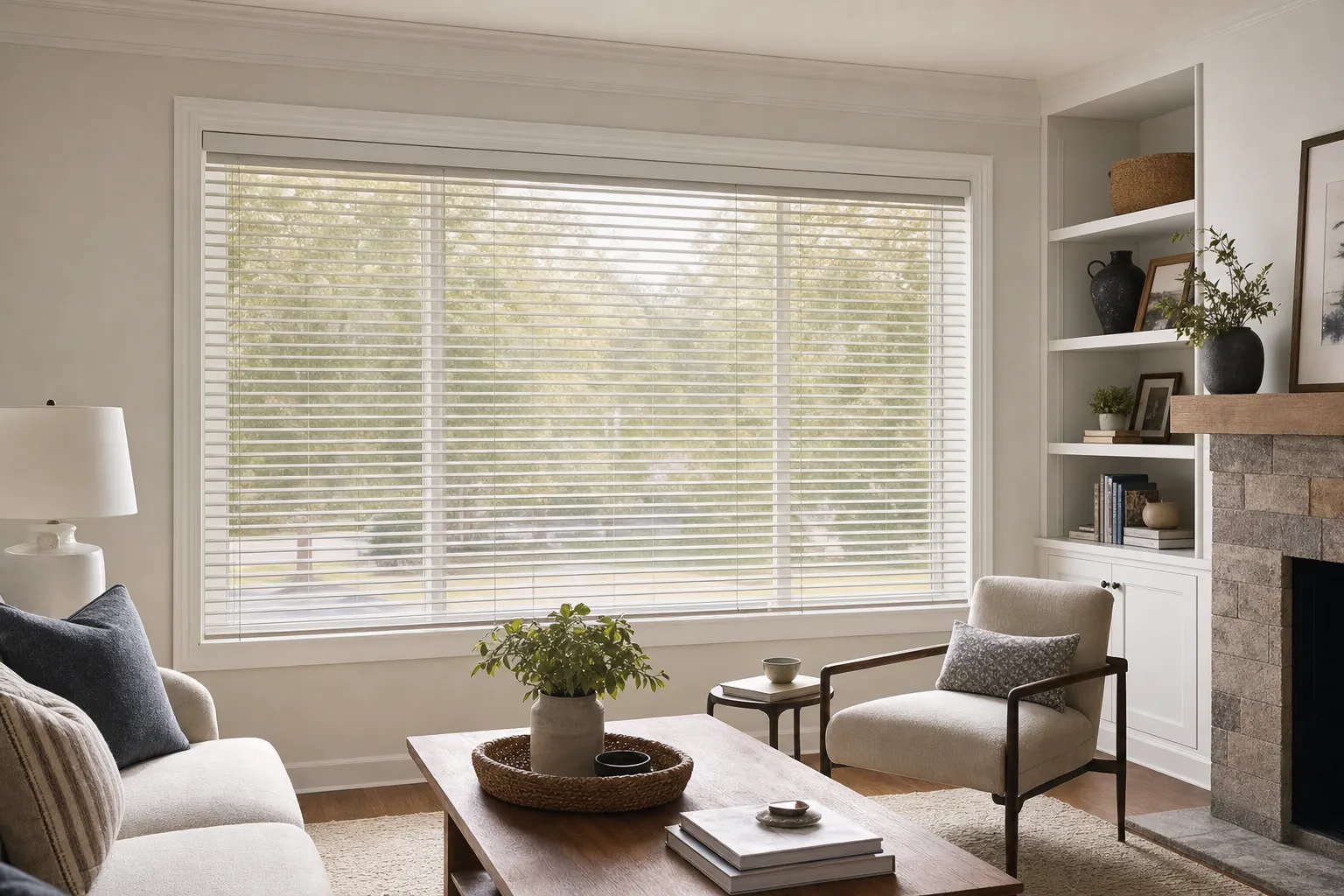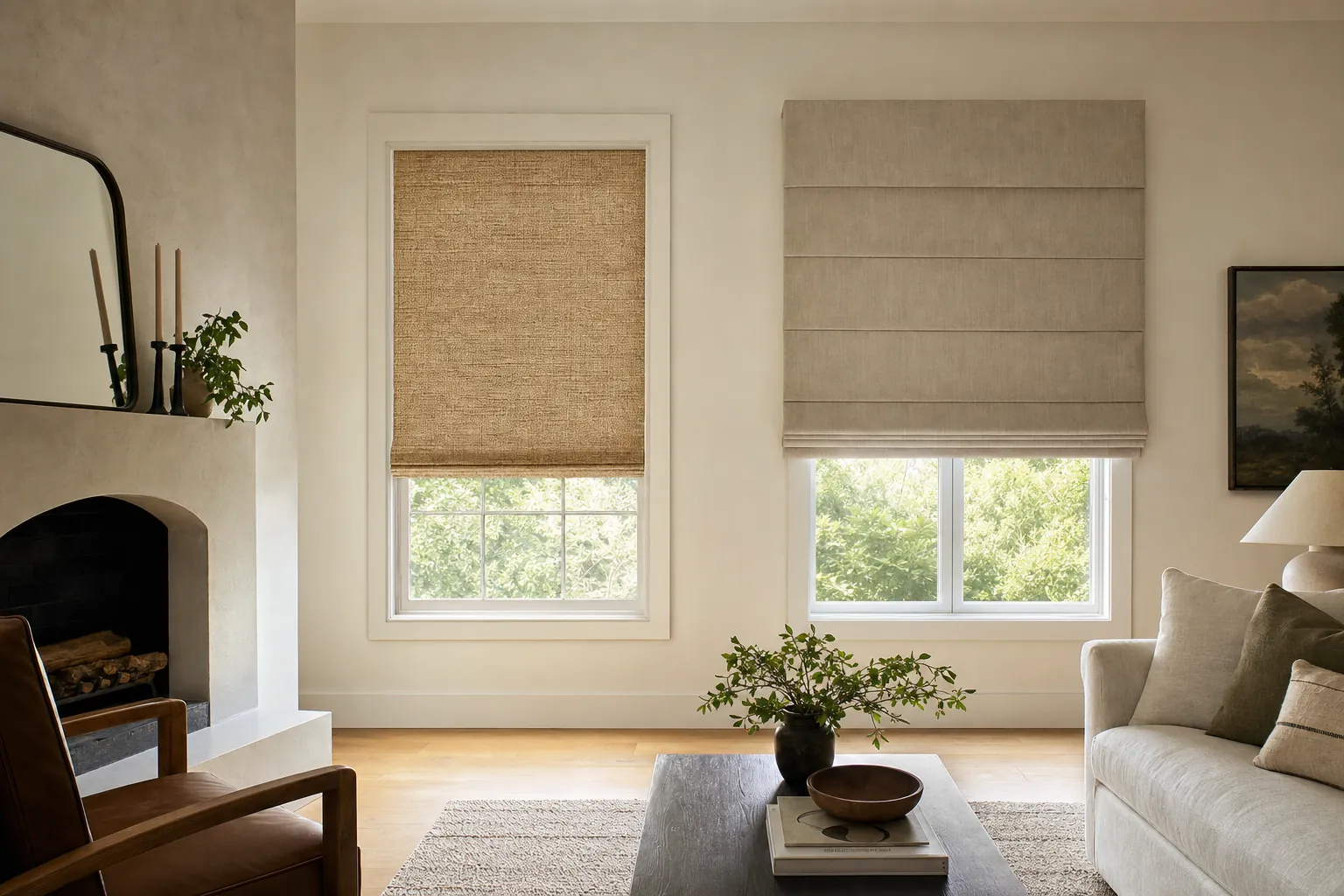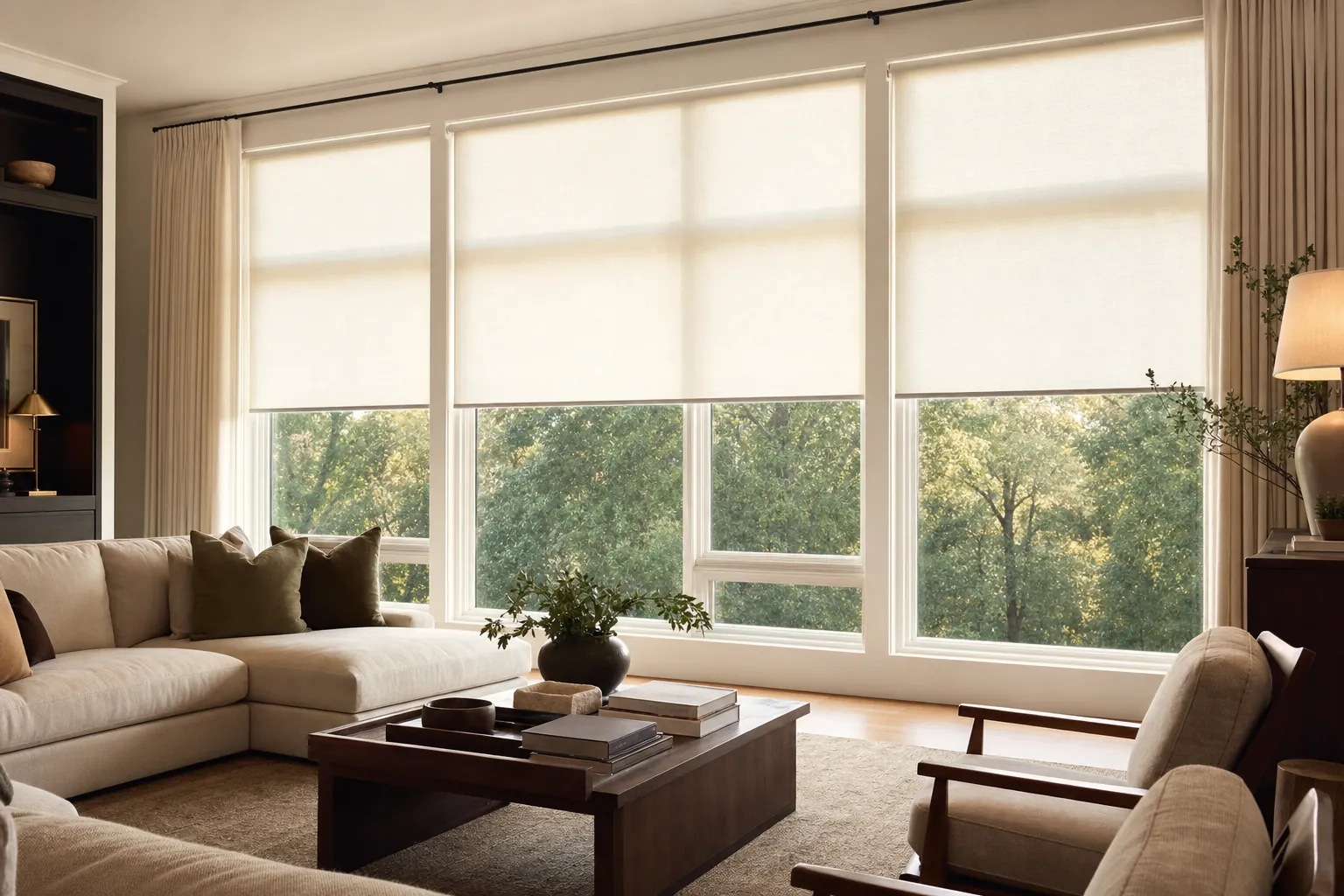

Roller shades and Roman shades can both make a window feel finished, but they solve the room in different ways. Roller shades create a clean, continuous plane for glare control and privacy. Roman shades bring fabric, folds, and visual softness. The right choice starts with the job the window has to do every day, then works back toward the look you want.
That distinction matters more than a color swatch. A bright home office may need a flat shade that settles screen glare without making the room feel closed in. A bedroom may need a lined fabric treatment that feels calm at night and adds warmth in the morning. A formal dining room may need the texture and proportions of a Roman shade. A sun-facing condo wall may need the quiet simplicity of several aligned roller shades. Start with function, then let the material and style support it.
The short answer
Choose roller shades when you want a streamlined look, continuous coverage across the glass, easy everyday operation, or a practical answer for glare, large windows, and modern rooms. Roller shades are especially useful when the treatment needs to disappear when raised and work hard when lowered.
Choose Roman shades when the room needs softness, fabric texture, a more decorative statement, or a treatment that relates closely to upholstery, drapery, and other textiles. Roman shades can still be practical, but their strongest advantage is the way they make a window feel intentionally dressed rather than simply covered.
Neither is universally better. The better question is whether the room needs the clean utility of a shade surface or the tailored character of fabric folds. The sections below make that choice more concrete, room by room, before a sample is ordered or a measurement is taken in your own home.
What roller shades do best
Roller shades are built around a simple idea: a single panel of fabric rolls neatly above the window when it is open and lowers into a flat surface when the room needs coverage. That clean movement makes them one of the most flexible choices for windows that are used often. There is little visual bulk, so a roller shade can sit quietly inside deep trim or extend beyond the opening when the room needs more edge coverage.
Fabric is what gives a roller shade its personality. A solar fabric can soften glare while keeping a sense of the view. A light-filtering fabric can diffuse hard daylight in a kitchen, office, or living room. A room-darkening fabric can work well in a bedroom when the mount and side coverage are planned honestly. The roller shade material overview from Hunter Douglas is helpful for seeing how broad the fabric choices can be, but the right openness, color, and lining still depend on the room.
Roller shades are often the most sensible answer when a window needs daily adjustments. They work well on wide windows, floor-to-ceiling glass, and groups of matching openings because several shades can align cleanly. They are also relatively easy to keep clean: the flat surface gives dust fewer places to settle, and there are no fabric folds to manage.

What Roman shades do best
Roman shades use fabric that gathers into soft folds as the shade rises. When lowered, the fabric creates a tailored panel across the window. The result is more dimensional than a roller shade and often feels warmer in rooms where a flat technical surface would look too spare.
That makes Roman shades particularly good for bedrooms, dining rooms, breakfast rooms, traditional living rooms, and spaces where the window treatment needs to participate in the room's fabric story. A linen Roman shade can echo upholstered chairs. A textured woven fabric can soften strong wood trim. A lined Roman shade can give a bedroom a more settled feel than a bare window or a minimal shade alone.
Roman shades also offer a wider range of visual expression. The fabric, fold style, trim, liner, mount height, and width all influence the finished result. The Roman shade collection from Hunter Douglas illustrates how fabric construction changes the character of the treatment. In a real room, though, the important check is whether the fabric feels right against the wall color, flooring, and daylight at different times of day.
The tradeoff is maintenance and visual weight. Roman shades have folds, seams, and more fabric, so they need careful cleaning. They also stack higher when raised than a low-profile roller shade. That is not a reason to avoid them. It is simply a detail to plan around when the view, trim, or top of the window needs to stay open.

Compare light control before you compare style
It is easy to assume a flat roller shade blocks more light than a Roman shade, or that a fabric Roman shade is automatically more private. Neither assumption is reliable. Light control comes from the fabric or liner, the mount, the edge overlap, and the way the treatment fits the opening.
Roller shades give you a clear path from bright and open to much more protective. A solar fabric can manage glare while leaving the room visually connected to the outdoors. A light-filtering roller shade can take the harshness out of daylight. A room-darkening roller shade can help a bedroom or media room, especially when it is mounted to cover the edges properly. For west-facing rooms, Lionheart's guide to blinds for west-facing windows explains why fabric openness and coverage matter more than a generic product label.
Roman shades can handle light beautifully as well, but the fabric choice needs to be made with more care. An unlined linen shade may make a bedroom glow softly, which is lovely in the morning and not enough at bedtime. A privacy or blackout liner changes that. For rooms that need strong daytime softness and more dependable nighttime privacy, a lined Roman shade may be the right balance. The best choice is made with the lights on after dark, not only with a sample held up at noon.
Mounting has a role too. An inside-mounted treatment can look crisp and architectural, but it may leave small edge gaps. An outside mount can add useful coverage over the opening. If the window is shallow, street-facing, or needs stronger room-darkening, read Lionheart's comparison of inside and outside mount blinds before choosing either style.
Privacy after dark changes the decision
Daytime privacy and nighttime privacy are different problems. During the day, a treatment may soften a view into the room while still letting in enough light to keep the space pleasant. After dark, the interior is brighter than the exterior, and a sheer, solar, or loosely woven fabric can behave very differently.
Roller shades make this decision easier when the room needs simple, consistent coverage. A room-darkening or more opaque roller fabric can lower into one continuous panel, which is useful for a street-facing bedroom, a bathroom, or a living room where the lights stay on late. If the room needs a view during the day and more privacy after sunset, a daytime solar shade plus lined drapery may be a stronger plan than one compromise fabric.
Roman shades can provide excellent privacy too, especially when lined and mounted with enough overlap. They are often a better emotional fit for a bedroom or a traditional room because the fabric adds warmth as well as coverage. The details matter: a light-colored fabric without a liner may show more glow at night, and a shade that stops inside a narrow frame will not cover the window the same way as one mounted above the trim.
For a broader room-by-room privacy decision, Lionheart's guide to the best blinds for privacy can help you decide whether you need adjustable slats, a continuous shade, a liner, or a second layer.
Consider the room's architecture
Roller shades tend to recede. Their clean profile suits contemporary interiors, large glass walls, minimal trim, kitchens, offices, and spaces where the furniture or view should remain the main event. They can also work in more traditional homes when the fabric and mounting details are selected carefully. The point is not that roller shades are only modern. It is that their form is quiet.
Roman shades tend to add presence. The folds create a visual break at the window and introduce texture even when the fabric is a calm neutral. This is useful when a room needs softness or when the window sits near upholstered furniture, drapery, wallpaper, or detailed millwork. A Roman shade can make a simple window feel more considered without requiring full-length panels.
Scale is where many choices go wrong. A modest kitchen window can take a Roman shade that feels charming and tailored. A massive wall of glass may need several roller shades that stay visually aligned. In a room with wide or tall windows, the guide to window treatments for large windows explains how stack height, view, shade divisions, and daily operation change the answer.
Maintenance, durability, and everyday use
Roller shades are generally easier to live with when the room sees regular activity. The fabric lies flat, the movement is straightforward, and cleaning usually involves gentle dusting or following the manufacturer's fabric-care guidance. They are practical in kitchens, children's rooms, home offices, and windows that are opened and closed throughout the day.
Roman shades are not fragile, but they require more thoughtful care. Folds can collect dust, textured fabrics can hold lint, and a stain on a light fabric is more noticeable than a mark on a darker roller shade. That does not make them unsuitable for busy rooms. It simply means the fabric should fit the life of the room. A performance fabric, a sensible color, and a practical liner can make a Roman shade a much more durable choice than a delicate fabric selected only for appearance.
Operation matters as well. Both styles can be cordless and both can be motorized. Roller shades are often the simplest motorized choice for multiple windows or a wide span because the shades can move together with a consistent lower edge. Roman shades are well worth motorizing when the window is hard to reach or the fabric treatment needs to stay neat and easy to use. Lionheart's motorized shade service can help plan power, controls, and daily routines before the fabric is ordered.
Fabric and color can change the answer
With roller shades, the fabric often controls whether the treatment disappears into the room or becomes a graphic element. A warm ivory light-filtering fabric can feel almost architectural against pale walls. A charcoal solar fabric can add definition around large contemporary windows. A darker fabric may improve glare control but can make the room feel more closed when the shade is down. A light fabric can keep the room bright, but it needs to be evaluated for nighttime privacy before it is selected for a street-facing window.
Roman shades put fabric even more visibly at the center of the decision. Linen, woven texture, subtle pattern, and lining can pull the window into the rest of the room. That is an advantage when the treatment should add personality. It is also why a fabric that looked perfect on a small swatch may feel too busy, too cool, or too delicate once it covers a full window. Look at the fabric near the floor, cabinetry, upholstery, and wood trim. Watch it in morning light, late afternoon light, and with the lamps on. The color that works in one condition may not be the color you want to live with all day.
For either style, consider what happens when the shade is raised. Roller shades usually roll into a compact tube at the top of the window. Roman shades gather into a stack of fabric. The stack can be elegant and intentional, but it has more visual presence. In a room with a beautiful transom, a shallow ceiling line, or a view worth protecting, that difference can decide the style before any fabric is chosen.
Measure the top of the window, not just the glass
Homeowners often begin by measuring width and height, then discover late in the process that the treatment has nowhere sensible to sit. Roller shades need space for their brackets, tube, and any cassette or fascia. Roman shades need room for hardware and a fabric stack when raised. Both may need an outside mount when the opening is shallow, a handle projects into the recess, or the trim is too valuable to crowd.
Look above the opening as closely as you look at the opening itself. Is there enough wall space to mount the treatment high enough for the finished proportions? Is crown molding in the way? Does a door swing into the treatment? Is the sill deep enough to keep the lower edge clear? A shade that fits technically can still look squeezed if it is mounted too low or pushed awkwardly under a ceiling detail.
This is especially important for adjacent windows. One window may have a crank, another may sit behind furniture, and a third may be close to a door. The finished room can still look unified, but the mounting approach may need to adapt. Treating every window as the same rectangle is how a well-chosen product ends up working poorly in the room.
There is also a practical question about where the treatment goes when it is open. A roller shade leaves a compact roll at the top, which can preserve more glass and make it easier to enjoy a view. A Roman shade gathers into folds, so its stack should be planned high enough not to sit heavily across the upper part of the window. If you are deciding between the two because the room has beautiful trim or unusually tall glass, bring a photo and rough measurements to the consultation. It speeds up the conversation and makes the real fitting constraints visible early.
What makes one option more expensive
The final investment is shaped less by the name of the treatment than by the details that make it custom. Width, height, fabric, lining, lift system, mounting, number of windows, and motorization all matter. A large roller shade with a specialty solar fabric and coordinated controls may require more planning than a simple fabric Roman shade on one modest window. A lined Roman shade in a performance fabric can involve more material and fabrication than a straightforward light-filtering roller shade.
The useful comparison is not simply, "Which one costs less?" It is, "Which choice will keep doing the job this room needs?" A roller shade that solves heat, glare, and screen visibility may be the better long-term value in an office. A Roman shade that adds softness, privacy, and a finished look may be the better value in a bedroom or dining room where a minimal shade would leave the room feeling incomplete.
Good measurement protects the investment in either case. A treatment that is ordered too narrow, mounted without enough clearance, or selected without testing the fabric in the room can create an expensive compromise. That is why Lionheart combines material guidance with measured fitting and installation, rather than treating the product choice as separate from the final result.
Choose by room, not by a showroom display
Home office: Start with roller shades. A solar or light-filtering fabric can cut screen glare without making the room feel like it has been shut down. If the window faces hard afternoon sun, a more protective fabric or scheduled motorization may be worth considering.
Bedroom: Start with the sleep plan. A lined Roman shade can bring softness and privacy, while a room-darkening roller shade can offer a more minimal look. If darkness matters, ask how the mount, side gaps, liner, and any drapery layer will work together.
Living room: Let the view and architecture lead. Roller shades work well when the room needs calm glare control. Roman shades are strong when the room needs texture and a fabric finish. Large windows may benefit from roller shades plus drapery rather than asking one treatment to do every job.
Kitchen or breakfast room: Roller shades are often the more practical choice because they are simple to wipe around and visually light. A Roman shade can still be beautiful here, especially in a tailored fabric, but it should sit clear of splashes, steam, and windows that are opened often.
Dining room: Roman shades frequently earn their place in a dining room because the fabric adds warmth and visual proportion. For bright exposure, a lined or light-filtering fabric can keep the room pleasant without losing the sense of occasion.
Street-facing room: Begin with privacy, then choose the style. A roller shade may provide the most straightforward coverage. A lined Roman shade may be the more decorative choice. In either case, check the room at night before deciding the treatment is private enough.
How Lionheart helps you decide
The roller-versus-Roman decision becomes much easier at the window itself. Lionheart can look at the trim, depth, view, sun exposure, neighboring sightlines, furniture placement, and how the room is used at the times that matter most. That is the context a showroom display cannot provide.
An in-home consultation lets you compare roller fabrics and Roman shade textiles in the actual daylight of the room. You can see whether the window wants to look quieter or softer, whether a liner is necessary, and whether an inside or outside mount will make the treatment function as well as it looks. Lionheart's roller shade guidance and Roman shade guidance are useful next steps when you already know which direction feels closer to the room.

Frequently asked questions
Are roller shades or Roman shades better for privacy?
Both can provide good privacy when the fabric and mount are chosen for the room. Roller shades are a strong choice for continuous coverage, while Roman shades can be lined for more privacy and a softer fabric finish. Street-facing rooms and bedrooms should be checked after dark, because daytime privacy does not always translate to nighttime privacy.
Do Roman shades block more light than roller shades?
Not automatically. Light control comes from the fabric, liner, mount, and edge coverage, not the shade style alone. A room-darkening roller shade can block much more light than an unlined Roman shade, while a lined Roman shade can be a strong choice for a bedroom that needs a warmer, more decorative look.
Which is easier to clean, roller shades or Roman shades?
Roller shades are usually simpler to maintain because they have a flat, continuous surface that can be dusted or gently cleaned according to the fabric guidance. Roman shades have folds and more fabric detail, so they need more careful vacuuming and spot cleaning, especially when the fabric is textured or lined.
Can roller shades and Roman shades be motorized?
Yes. Both styles can be motorized when the room benefits from easier daily operation. Roller shades are especially straightforward for wide glass, glare-prone rooms, and several matching windows. Motorized Roman shades can work well in bedrooms and formal rooms when the fabric treatment should move on a schedule or remain easy to reach.